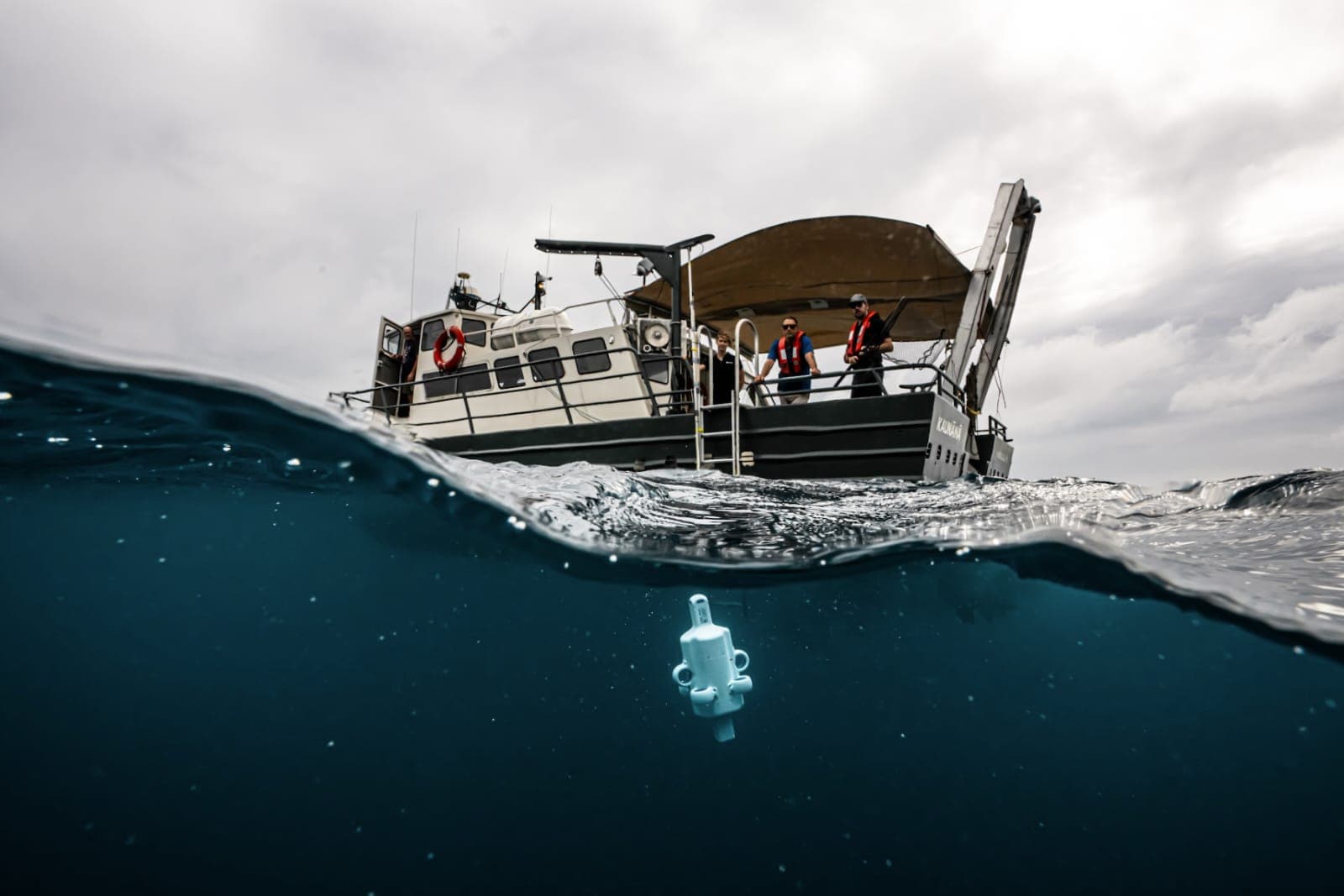
Evaluating Hydrus MicroAUV for Benthic Survey: Performance Evolution, Feedback Integration, and Expected Capabilities
Executive Summary
This paper documents the development, field validation, and operational performance of the Hydrus 300m rated microAUV, a compact, user-friendly autonomous underwater vehicle developed by Advanced Navigation for benthic habitat mapping and ecological monitoring. From its initial deployments in 2023 through extensive NOAA-coordinated trials in 2024 and 2025, Hydrus underwent significant refinement—culminating in a series of validation missions across the Florida Keys in May 2025.
These trials evaluated Hydrus' performance across five core criteria: mission success rate, mission quantity, navigational accuracy, scaling precision, and image quality. With targeted improvements to firmware, sensor fusion, acoustic aiding, and mission logic, Hydrus consistently achieved:
- Over 92% mission success across 71 missions, with >95% success under routine conditions
- Navigation drift <2.5 meters, with INS stabilization in under 20 seconds
- High-resolution orthomosaics (~0.5 mm/pixel) with minimal manual alignment
- DVL-based scaling accuracy of 1.8% RMS, validated against physical scale bars
- Autonomous recovery within 1–2 meters of programmed surfacing location
- Prototyped AI for coral classification (YOLOv5) with promising early performance
Key Findings
Hydrus demonstrated a reliable and scalable path forward for replacing or augmenting diver-based survey methods. It reduces personnel and vessel requirements by up to 50%, enables up to 15 missions per day, and improves safety and repeatability in high-frequency monitoring programs.
Valuable insights from these deployments included the opportunity to further refine the INS. While missions were successfully executed, the learnings are now guiding sensor fusion improvements to deliver even greater accuracy.
Performance Evolution
Through a structured program of real-world testing, iterative refinement, and stakeholder engagement, the Hydrus microAUV has evolved into a capable, scalable solution for shallow-water benthic surveys. From its early deployments in 2023 through its final validation during NOAA's 2025 Florida Keys field trials, Hydrus demonstrated substantial improvements in mission reliability, navigational accuracy, photogrammetric quality, and system autonomy.
Across 71 missions in Florida, Hydrus achieved a mission success rate exceeding 98%, with only one hardware-related failure. INS stabilization times dropped below 20 seconds, and average navigation drift was reduced to under 2.5 meters under typical conditions.
Conclusion
With its proven performance, compact deployment profile, and ongoing system enhancements, Hydrus is now positioned as a practical, field-ready tool for coral reef mapping, habitat classification, and broader nearshore ecological applications. The system's progress over the last two years underscores the value of field-driven engineering and active stakeholder collaboration in developing operationally ready marine robotic systems.
Hydrus is no longer a prototype—it is a platform ready for the demands of modern ocean monitoring.